DiT-Garment: Garment Dynamics with Diffusion Transformers

1Inria Centre at the University Grenoble Alpes
2Inria, University of Rennes, CNRS, IRISA-UMR 6074 3Interdigital Inc.
Arxiv 2026
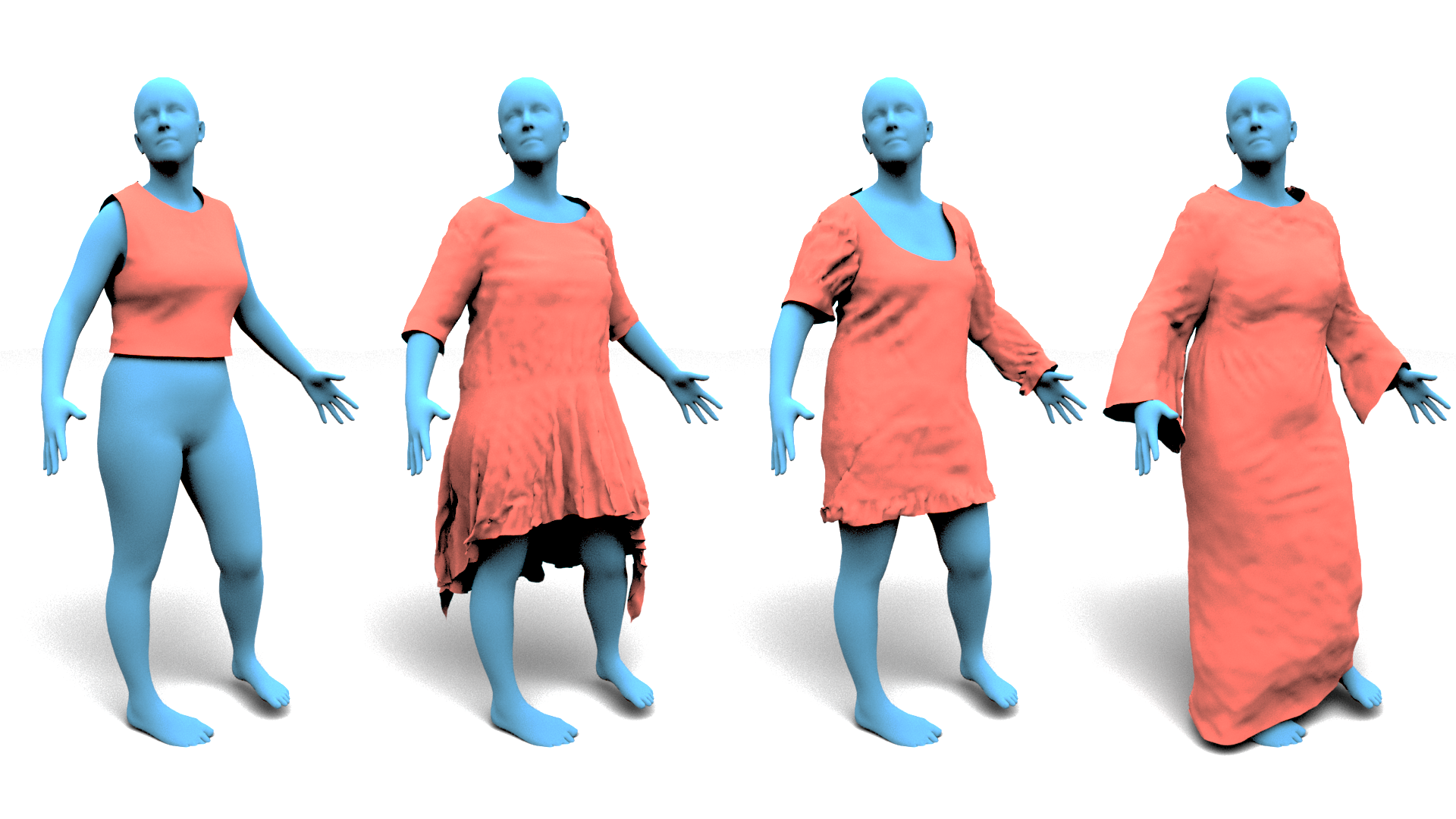
Teaser DiT-Garment animates arbitrary garment designs over any human body in any target pose. Given a body motion and physical parameters, DiT-Garment directly infers dynamic garment deformations for a design seen during training (left) and generalizes to three unseen designs (right), without retraining.

Abstract

We present DiT-Garment to model dynamic 3D clothing over human body models in arbitrary motion. Unlike existing methods, DiT-Garment can animate garments with unseen designs and physical materials, while allowing for direct inference of deformations for any target pose. To achieve this, we leverage a 2D diffusion transformer architecture to learn 3D deformations in a 2D UV-space. As the result is non-deterministic, our generative model learns the distribution of possible outcomes. The template garment is represented as a 3D triangle mesh spatially aligned with a 3D human body model in a standardized pose. To work with different garment designs without the need of a common template or complex graph convolution operations, the diffusion transformer is conditioned on a 3D position map of the template, represented in UV-space, which allows to implicitly learn a deformation of the 3D space around the body in standard pose. Further conditioning on body motion and physical parameters allows to physically ground the model. We quantitatively and qualitatively evaluate DiT-Garment on both synthetic and real data. While only trained on synthetic simulations of automatically generated cloth designs, our method generalizes to captured and artist-made garment designs.

Overview

Model overview

DiT-Garment generates garment deformations for a given template representing a garment design conditioned on body shape β, motion θt-l:t and cloth material γ. It builds upon a 2D diffusion transformer model (DiT) to learn how to deform a template in UV-space. 3D geometric features are parameterized by the UV parametrization of the template, and we concatenate the position map to the diffusion noise. Our model infers the garment dynamics by iteratively denoising the Gaussian noise to the displacement map.

Video

BibTeX

If you find our work useful, consider citing:

@misc{dumoulin2026ditgarment,
  title={DiT-Garment: Garment Dynamics with Diffusion Transformers}, 
  author={Antoine Dumoulin and Laurence Boissieux and Joao Regateiro and Pierre Hellier and Stefanie Wuhrer},
  journal={arXiv preprint arXiv:2609.18510},
  year={2026},
  url={https://doi.org/10.48550/arXiv.2609.18510}, 
}